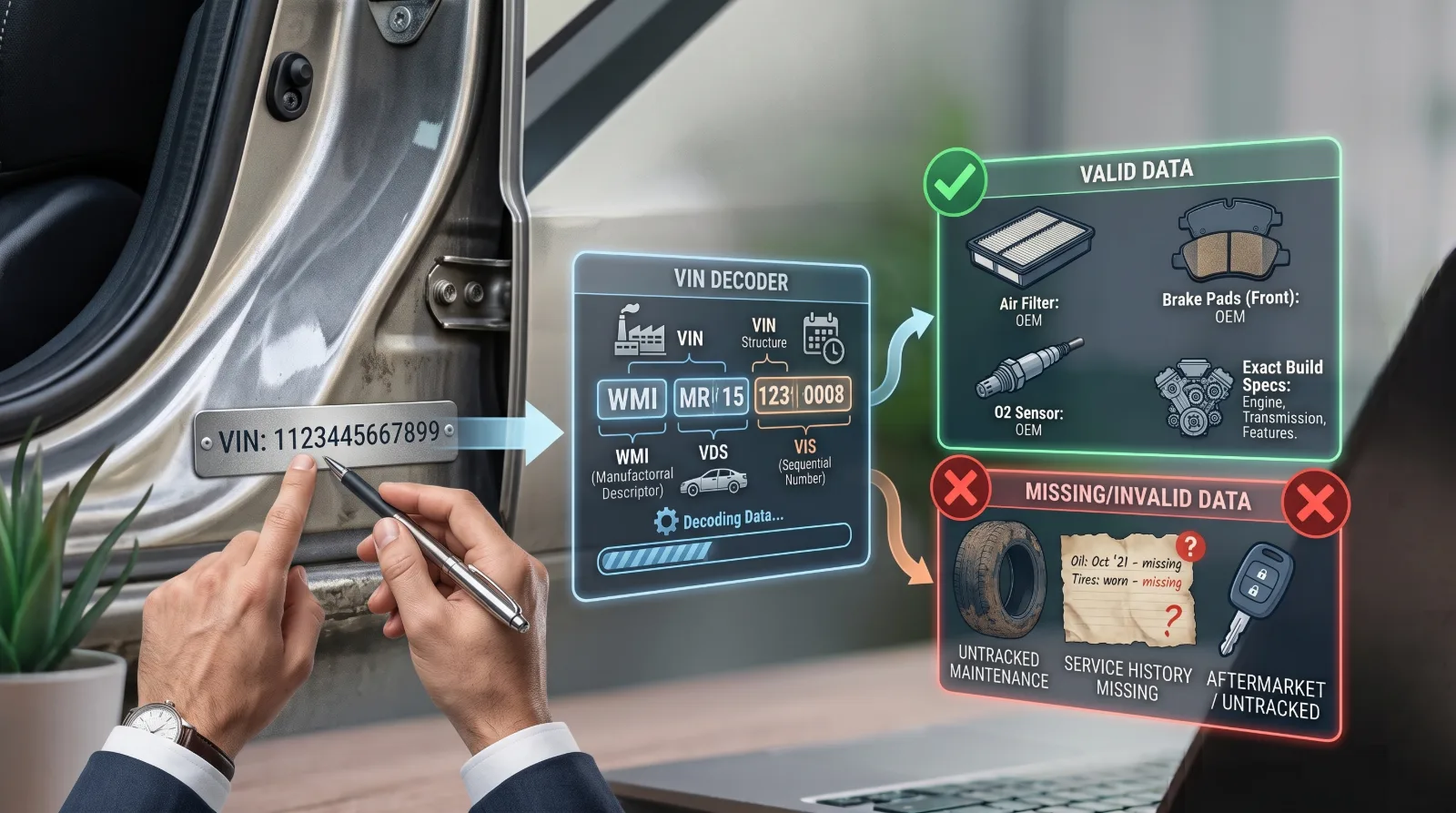
The VIN identifies the car. It does not identify what is bolted to it.
A donor vehicle arrives and there are two hundred sellable parts on it. The chassis number is the single best piece of information you have, and knowing precisely where it stops being useful is the difference between listings that sell and listings that come back.
Most guides to this are written for buyers trying to source a part. This one is written for the other side of the transaction: you already have the vehicle, and you need every part off it described accurately enough that a buyer’s search finds it and their car actually takes it.
Terminology first, because it causes real confusion. Chassis number, VIN and frame number usually mean the same seventeen characters. The exception worth knowing is older Japanese domestic vehicles, which may carry a model code and serial in a different format entirely. If a decoder rejects your number and the car is a JDM import, that is almost always why, not a typo.
What a free decode actually returns.
The US government runs a free VIN decoding service, vPIC, with no commercial restriction. It is the honest baseline for this question, so we ran a live decode rather than describing one.
Decoding NHTSA’s own sample VIN for a 2003 Honda Accord on 31 August 2026 returned 32 populated fields out of 140. Make, Model, Model Year, Body Class, cylinder count, displacement, trim and assembly plant all came back. Series came back empty.
Thirty-two fields describing the car. Zero fields describing a part.
That is not a criticism of the service, which does exactly what it is built for. It is the structural point: a VIN decode resolves the vehicle. Going from a vehicle to a part number is a second lookup against a completely different dataset, and that is the step where cost and error live.
The decode above is reproducible in a browser through the NHTSA vPIC API. Field counts move as the schema changes, so treat any published figure, including ours, as dated rather than permanent.
Four steps, and everyone skips the middle two.
Going from a chassis number to a part number you can list against is four moves. Only the first is automatic, and the two that get skipped are the two that produce returns.
Step 01: Decode the vehicle
- Seventeen characters resolve to make, model, year, body and engine family. Free tools do this well.
- This is the step everyone does, and it is the only fully automatic one.
Step 02: Narrow to the build (the skipped one)
- Market, factory options and production date decide which variant was actually fitted.
- Free decoding generally stops here, and this is where the wrong part gets chosen.
- The same model built for different markets can take different parts. Cooling, filtration and anything exposed to heat or dust diverge most.
Step 03: Find the part in the catalogue
- Locate the assembly, usually through an exploded diagram, and read off the original number for that build.
- The second step people do reliably, which is why steps one and three feel like the whole job.
Step 04: Decide which number you are actually selling (the other skipped one)
- The original OE number, the number that superseded it, or an aftermarket equivalent under a different number entirely.
- These are three different listings with three different buyer searches attached to them.
- Getting this wrong is not a cosmetic error. It decides whether the listing is findable at all.
Supersession is why the number on the part returns nothing.
When a manufacturer revises a part, the old number is retired and points at a new one. That happens repeatedly across a vehicle’s life, so a part can sit at the end of a chain three or four numbers long.
Consequence 01: Your search returns nothing
The number physically printed on the part you pulled may have been retired years ago. Searching it returns nothing, and the natural conclusion, that the part is unlisted or obscure, is wrong.
Consequence 02: An old number drags an old vehicle list
This is the one that costs money. A listing built against a superseded number often inherits that number’s original vehicle list, producing fitment that looks complete and is quietly wrong. Related: fitment that fails silently.
One subtlety that catches people out: supersession is directional. The new number replaces the old one, but the old part does not always fit everywhere the new one does, particularly where the revision changed a mounting point or a connector. Treating the chain as interchangeable in both directions is a reliable way to generate returns.
Where the chassis number genuinely cannot resolve it.
Sometimes the honest answer is that seventeen characters do not carry the information, and anyone who gives you a confident answer is inferring rather than knowing.
Limit 01: Option codes
Where a variant is selected by a factory option rather than by model, the VIN does not encode which one was fitted. The option code label does.
Limit 02: Running changes mid model year
A supplier change partway through a production run splits one model year into two parts. Year, make and model cannot distinguish them.
Limit 03: Build date boundaries
Two cars, same model year, different months, different part. The build date resolves it and the seventeen characters usually do not.
Limit 04: What the catalogue cannot tell you
An OE catalogue gives the number for the build. It will not reliably tell you the current live number after supersessions, which aftermarket brands make an equivalent, or what any of it is worth.
In all four cases the correct move is the same and it is not clever: read the number off the part in your hand, or photograph the label, rather than accepting an inferred answer. A tool that admits it cannot resolve a variant is more useful than one that picks confidently and is right most of the time, because you cannot tell which listings are in the wrong bucket until the returns arrive.
For one-off OE lookups on mainstream brands, a free catalogue such as 7zap covers around seventy manufacturers with VIN lookup and exploded diagrams, and that is a complete answer for occasional use. Our parent company covers the sourcing side of this question, finding who actually has the part, in chassis number to part number.
What changes when it is two hundred parts, not one.
Every step above is tractable by hand for a single part. The problem is that a dismantler does not have a single part, and the per-part cost of doing steps two and four properly is what quietly decides whether a yard lists its inventory or leaves it on the shelf.
This is the case YardScan is built for. Scanning the donor VIN establishes the vehicle once, then resolves the parts it carried against verified vehicle-to-part relationships, so the identification work happens per vehicle rather than per part. Where a variant is genuinely ambiguous, the answer is to surface it for a decision rather than to guess, which is the same principle as the section above.
| Metric | What it means |
|---|---|
1.17B |
Verified relationships, vehicle to part. The second lookup, the one a VIN decode cannot do on its own, run against verified relationships rather than inferred from a number. |
1 |
Scan per vehicle, identify once. The donor car is established once and every part pulled from it inherits that identification. |
2% |
Surfaced for review, ambiguity stays visible. Where the data does not resolve cleanly it becomes an editing task instead of a confident wrong answer. |
VIN decoding coverage, catalogue completeness and supersession records vary by manufacturer and by market, and no dataset is complete.
Where a part carries a readable number, the number on the part remains the most reliable input available.