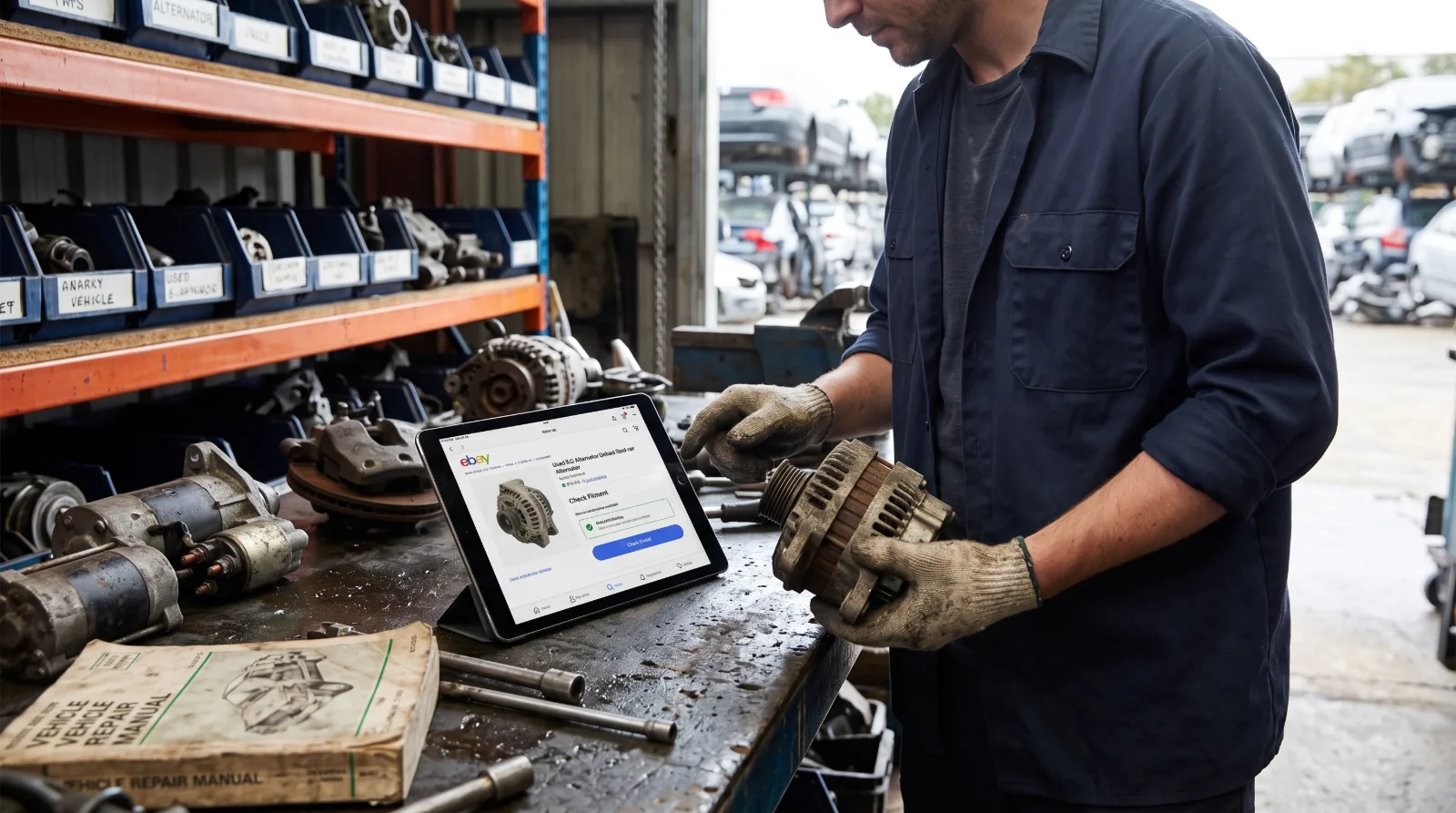
Almost every fitment tool looks up a part number. Your inventory does not have one.
This is the sentence that decides which tools can work for a salvage yard and which cannot, and it gets lost in every comparison table. eBay Fitment Plus Auto, and most listing software that advertises compatibility, works the same way underneath: take the brand and the manufacturer part number off the listing, look them up in a catalogue, and attach the vehicle list that catalogue returns.
A used control arm pulled off a donor car has no brand in the aftermarket sense and often no legible part number at all. There is nothing to look up. The listing is not badly matched, it is unmatchable, and it stays that way no matter how many weekly cycles run over it.
That distinction matters because it changes what you are shopping for. A gap that will be filled later is worth waiting out. A limit built into the mechanism is not. Vintage parts, modified parts and universal-fit items sit on the wrong side of the same line for the same reason.
A part with no number is not poorly served by catalogue lookup. It is invisible to it.
Three approaches, not fifteen products.
Strip the branding away and the market offers three ways of producing a vehicle list. Working out which one a product actually uses tells you more than any feature grid, and it is a question most vendor sites do not answer directly.
Approach 01: Catalogue lookup on brand and part number
- What eBay Fitment Plus Auto does, free and built in, on a weekly cycle against eBay’s own compatibility database.
- Correct answer for branded aftermarket stock with clean part numbers sold only on eBay. If that is you, take it and stop reading.
- Structurally blind to anything without a brand and a number, and eBay’s own database is documented as thin on modified, universal and vintage items.
- Worth knowing: eBay still holds you responsible for fitment accuracy, including on data eBay itself added.
Approach 02: Bring-your-own-data platforms
- Serious multichannel operations built around ACES and PIES, where the software gives you the pipes and you license the data separately.
- SureDone is the established example and says on its own site that it does not supply fitment data itself.
- Real cost is the platform plus a data subscription from a provider such as PCFitment or SEMA Data. Model both before comparing to anything else.
- Strong if you already own your catalogue data. It does not solve a part that was never in a catalogue.
Approach 03: Vehicle-first resolution
- Start from the donor vehicle rather than the part: decode the VIN, establish exactly what the car is, then resolve which parts it carried.
- The only approach that produces a vehicle list for a part with no readable number, because the identifying information comes from the car.
- This is the approach salvage and dismantling inventory actually needs, and the one fewest products implement.
- Ask any vendor directly whether their fitment works from a VIN or is a catalogue lookup wearing different words.
We have deliberately left pricing out. Vendor rates change, published sources already disagree with each other, and a dated price table ages into a liability. Our parent company maintains a vendor-by-vendor comparison with prices and a checked-on date in eBay auto parts listing tools compared. Verify any figure against the vendor’s own site before buying.
Two tools died this year. Both taught the same lesson.
2026 has been an unusually bad year for eBay parts tooling, and the pattern in both failures is worth more than the individual news.
June 2026: inkFrog went dark
Wix announced the closure on 29 April 2026 and the servers went offline on 1 June, with CSV export closing on 31 May. Because inkFrog templates pushed HTML that referenced inkFrog’s own image servers, listings broke across affected sellers the moment the CDN stopped answering.
September 2026: myFitment closes
eBay folds the capability in-platform on 30 September 2026 and cuts off third-party and Amazon access, with no export tool and no migration path. We cover what to do in the closure checklist.
Neither failure was about price or features. In both cases sellers discovered late that data they thought of as theirs lived somewhere they did not control, and that getting it out was either time-boxed or impossible. So add two questions to any evaluation, ahead of the feature list: can I export my fitment data on demand, in a format something else can read, and does anything this tool publishes depend on the vendor’s servers staying online after I stop paying?
inkFrog closure timeline documented by Frooition, a competitor of ours whose write-up is the clearest public record of it. myFitment third-party cut-off reported by Value Added Resource.
Test any tool in an afternoon, with your own parts.
Every claim on this page, ours included, is checkable against your own inventory faster than reading another comparison. Pick the parts most likely to break things rather than the easy ones.
Test 01: Pick twenty awkward parts
Not twenty clean branded units. Twenty that represent your actual stock: no legible number, a superseded number, a reman equivalent, and something where the variant depends on engine code rather than model year.
Test 02: Count coverage and over-application separately
How many produced a vehicle list at all, and how many produced a list claiming vehicles the part does not fit. The second number is the one that costs you money in returns.
Test 03: Run the same twenty through eBay’s free tool
It is the baseline any paid option has to beat. If a paid tool matches the same parts the free one already handles and misses the same ones, it is not solving your problem.
Test 04: Try to export before you commit
Ask for your fitment back out, in bulk, in a readable format, before the subscription starts rather than after. The answer to that question is what 2026 has been teaching.
Where GridX Connect fits, and where it does not.
We build the third approach. Fitment resolves against a graph of verified vehicle-to-part relationships, and YardScan starts from a donor VIN rather than a part number, which is the only route that produces a vehicle list for a part with nothing printed on it.
Where we are the wrong purchase, plainly. We publish into eBay Motors and have no Amazon integration, so if the pipeline you are replacing pushed fitment to Amazon, look at PCFitment, azFitment or SureDone instead. And if you sell branded aftermarket parts with clean part numbers on eBay only, eBay’s free tool is the right answer and we have no honest argument against it.
eBay’s programme rules, category coverage and enrolment defaults are eBay’s own mechanics and change over time, and every vendor described here can change what it does. Confirm the current position directly with any provider, including us, before making a purchase.
| Metric | What it means |
|---|---|
1.17B |
Verified relationships. Resolved, not looked up. Vehicle-to-part relationships behind each compatibility list, so a missing part number is not the end of the road. |
VIN |
Starting point. Vehicle-first. YardScan identifies the donor car, then what it carried, which is how a part with no legible number still gets a vehicle list. |
50 |
SKUs free. Test it on real stock. No credit card and no expiry, which is enough to run the twenty-awkward-parts test above on your own inventory. |