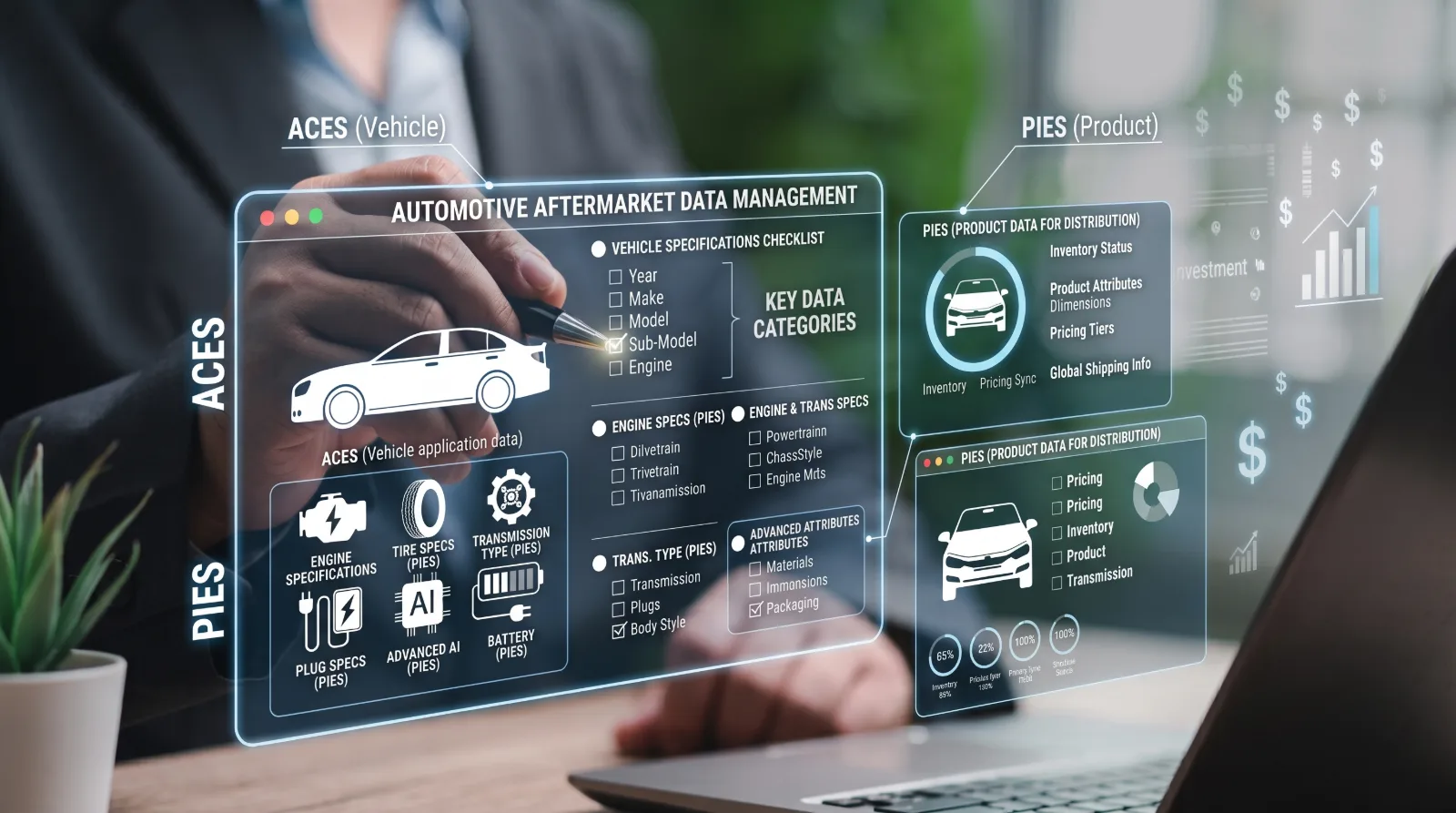
Most eBay parts sellers never need to buy any of this.
It is worth saying that before the pricing, because the most common expensive mistake in this area is buying reference data to solve a problem that did not require it.
Putting a vehicle compatibility table on an eBay listing and publishing an ACES file to a receiver are not the same activity. The first is a feature of the marketplace you are already selling on. The second is a data-distribution obligation that comes with owning a catalogue other businesses consume. If you sell parts on eBay, and possibly Shopify alongside it, you are almost certainly only doing the first.
What ACES and PIES actually are is covered in our plain-English guide to the standards. This page is about a narrower question: whether you need to license them yourself, and what it costs if the answer turns out to be yes.
Probably not you: Selling parts on marketplaces
Salvage yards, recyclers, resellers and e-commerce parts retailers listing on eBay, Shopify or similar. The marketplace supplies the compatibility mechanism. You supply accurate data into it.
Probably you: Distributing a catalogue to receivers
Brands, manufacturers and distributors whose part data is consumed by other businesses, or anyone publishing into receivers that require a conforming ACES file. That is when licensing becomes unavoidable.
What the reference data costs, if you do cross that line.
This is the one part of the number you can check yourself, because the Auto Care Association publishes its subscription tiers rather than quoting privately.
Access is banded by annual global revenue across many levels, with separate member and non-member rates and a member discount that is substantial enough that membership tends to pay for itself. Broadly, the fitment-side subscription runs from around three thousand dollars a year at the smallest member band into five figures at the largest non-member bands, and the product-side subscription is priced separately on its own scale. Publishing both fitment and product attributes means paying for both.
Two structural points matter more than the exact figures. A fitment subscription bundles the vehicle database together with the qualifier database, the product classification database and the brand table, and all of those are required to produce a conforming file, so it is not something you can partially buy. And it renews annually. This is a running cost, not a purchase.
We have given ranges rather than exact figures deliberately. Published tiers change, and a precise number that has quietly gone stale is worse than an honest range. The current rates are on the Auto Care Association subscriptions page. Our parent company published a full band-by-band breakdown with a checked-on date in what ACES and PIES actually cost.
Your SKU count is not what drives the bill.
This is why per-SKU pricing in this category tends to be wrong in both directions, and why quotes for apparently similar catalogues differ by more than ten times.
Driver 01: Applications, not parts
The real unit of work. A brake pad fitting four hundred configurations is not the same job as a trim clip fitting three, though both are one SKU. Five thousand parts might carry forty thousand applications or nine hundred thousand.
Driver 02: The state of your source data
One brand spelled four ways, part numbers with and without hyphens, the same part duplicated under two internal codes. Normalising that is the work that does not automate cleanly, and it is where estimates go wrong.
Driver 03: Free text that should be coded
“Front, except heavy duty suspension” typed into a notes field is not a qualifier. Converting it into one is a per-case judgement, and there is no shortcut through a large pile of them.
Driver 04: Digital assets
Images and documents to specification are a separate scope. If you do not already have them, that is a photography and production project sitting inside what looked like a data project.
The fifth driver is the one people underestimate most: each receiver applies its own rules on top of the standard. A file can be perfectly valid and still be rejected because a hyphen sits in an item attribute and not in the file. Walmart Marketplace, for instance, requires the part terminology ID, brand ID and manufacturer part number to match the ACES file exactly, spaces and hyphens included. Every additional channel is another reconciliation, and it recurs.
Two costs that are rarely in the proposal.
Missing 01: Somewhere to keep it
A cleaned catalogue has to live somewhere that can maintain it. That is a separate product with a separate bill, and a data project that ends with a delivered file has not finished the job.
Missing 02: Decay
The vehicle database changes every year: new model years, new configurations, corrections. A catalogue cleaned once and left alone begins decaying immediately. Any quote that reads as a one-off project has quietly omitted year two, and year two is what decides whether year one was worth paying for.
Hire, or buy the capacity?
Worth doing the arithmetic rather than assuming. Catalog and data manager roles are real, budgeted, recurring positions at parts brands, typically asking for several years of specific ACES and PIES experience. But the in-house comparison is never one salary against one invoice. It is a salary, plus the reference data subscription, plus somewhere to keep the catalogue, plus the coverage gap while you recruit, plus the fact that one person cannot audit a large catalogue and maintain it simultaneously. Catalog teams that work tend to be two to five people.
The honest rule is that hiring makes sense when the work is continuous, and buying makes sense when there is a backlog to clear. Most companies have both at once, which is why most end up doing both. Anyone telling you outsourcing always wins is selling outsourcing.
Where GridX Connect fits, and where it does not.
We are not an ACES and PIES service, and if what you need is a conforming catalogue distributed to receivers, we are the wrong purchase and a specialist catalogue provider is the right one.
What we do is the marketplace side: produce accurate vehicle compatibility on eBay Motors listings, aligned to the same standards underneath, without requiring you to license the reference data or run a catalogue operation. For a seller whose parts are sold rather than distributed, that is the part of the problem that actually needs solving.
Auto Care subscription tiers, receiver requirements and salary levels all change, and the figures described here are ranges rather than quotes. Confirm current pricing with the Auto Care Association and with any provider directly before budgeting.
| Metric | What it means |
|---|---|
$0 |
Reference data licensing. Nothing to subscribe to. No Auto Care subscription needed on your side to publish compatible listings on eBay Motors. |
419 |
eBay categories. Category-correct output. Compatibility written into the listing in the form the marketplace expects, per category. |
50 |
SKUs free. Test before deciding. Enough to compare what you get against what a catalogue project would need to deliver. |